
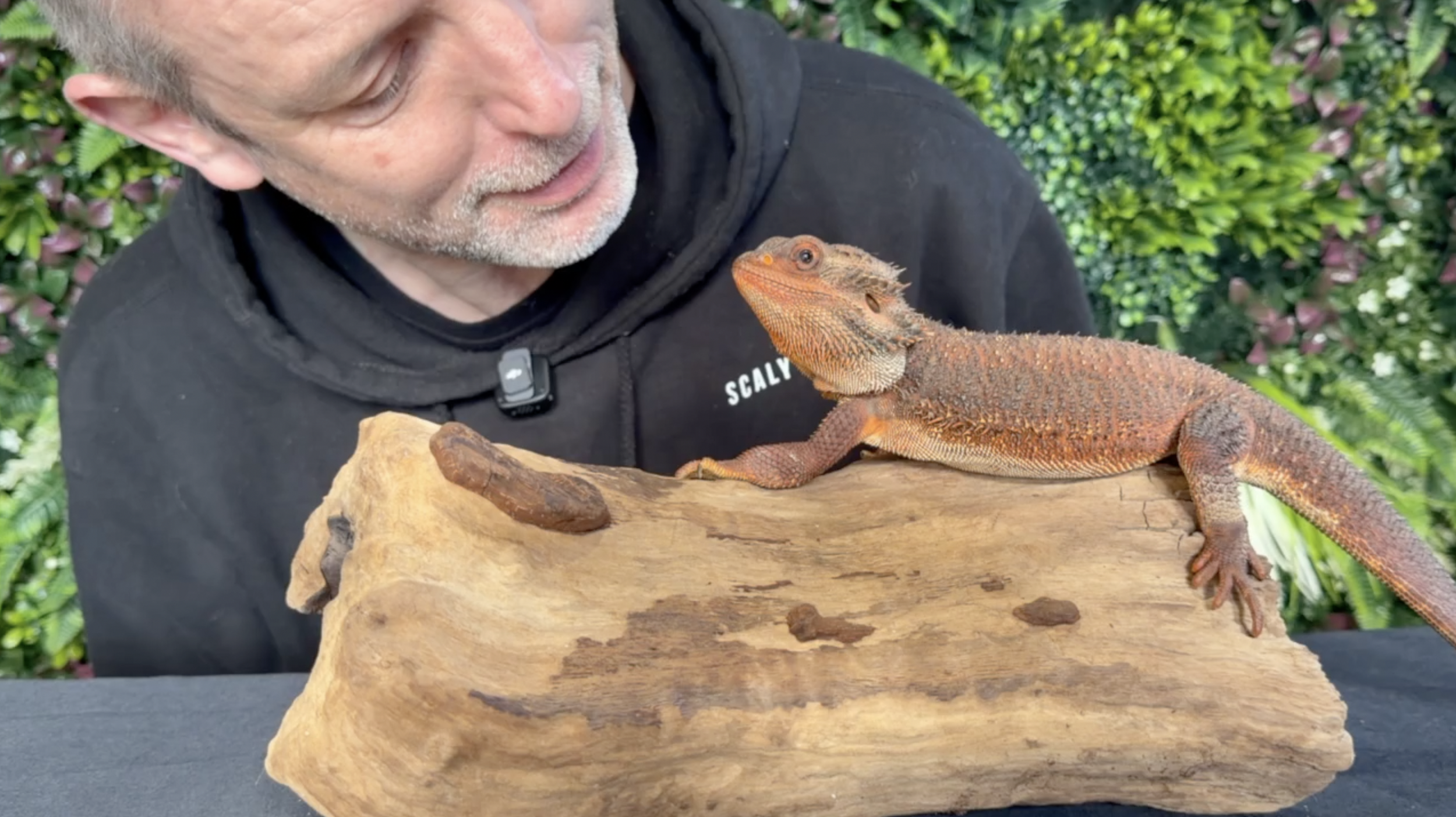
Animal Welfare
Their welfare comes first. Always.
Scaly Safari exists to help people understand, respect and care responsibly for reptiles and other exotic animals. Part of that work involves taking some of our animals out of their usual environments to meet members of the public, and we don't pretend that this has no implications for them. It does.
We believe strongly in the value of what we do, but with that comes a responsibility to make sure that any negative impact on our animals is carefully considered and minimised. Through our work, we teach children about the natural world, help families understand the reality of reptile ownership before bringing an animal home, challenge fear and misinformation, and introduce people to animals they may previously have disliked or feared.
We believe those experiences can have enormous value. But none of that gives us permission to compromise the welfare of the animals that make them possible. Their welfare comes first. Always.
What do we mean by welfare?
Animal welfare is a complicated subject, particularly when we're talking about reptiles and invertebrates. You'll notice, for example, that we're careful about describing our animals as “happy”. That's intentional. We can't ask a royal python whether she enjoyed meeting a class of Year 5 children, and we don't think it's responsible to project human emotions onto an animal and then use those assumptions as evidence of good welfare.
What we can do is assess the animal in front of us. We spend a huge amount of time with our animals and know what normal looks like for each individual. We monitor physical condition, body language, movement, feeding, shedding, temperament and behaviour, and we're particularly interested in changes from that individual's normal behaviour.
If an animal behaves differently, displays recognised signs of stress or shows a physical change, that's information that we take seriously. Our job is to listen to what the animal is telling us and act accordingly. If an animal shows us that an interaction, journey or environment isn't appropriate for them, we change the plan. No photograph, booking, timetable or customer expectation takes priority over that.
Why take animals out at all?
It's a fair question, and one we've thought about a great deal.
Reptiles and exotic animals are increasingly common family pets, but responsible ownership requires specialist knowledge. We regularly meet families whose child desperately wants a snake, gecko or bearded dragon while their parents understandably have no idea where to begin. Unfortunately, we also see what happens when an animal is bought without a proper understanding of its needs, costs or lifespan. This is one of the reasons responsible pet ownership has become such an important part of our work.
We also meet people every week who dislike snakes, hate spiders or are genuinely terrified of them. These animals are frequently misunderstood and sometimes treated as little more than things to fear, recoil from or use for shock value. We think they deserve better than that.
Sometimes it takes meeting an animal to change someone's perspective. A child who approaches us simply because they want to hold a snake might leave understanding that the same animal could live for decades and requires specialist heating, housing and care. Someone who has spent their entire life frightened of spiders might leave fascinated by them. A photograph can start a conversation, and a five-minute interaction can become the beginning of a lifelong interest in the natural world.
This is also why we're comfortable acknowledging that sometimes entertainment is the door through which education enters. We don't expect every eight-year-old to approach our stand because they're desperate for a detailed conversation about responsible exotic pet ownership. They might approach because there's a nine-foot snake and they think that's incredibly cool — and that's okay. Now we have their attention, and we have an opportunity to turn that excitement into curiosity, knowledge and respect.
Our events should be fun. But the animals aren't there simply to entertain people, and they're never props. There is always a purpose behind the interaction.
Choosing our animal ambassadors
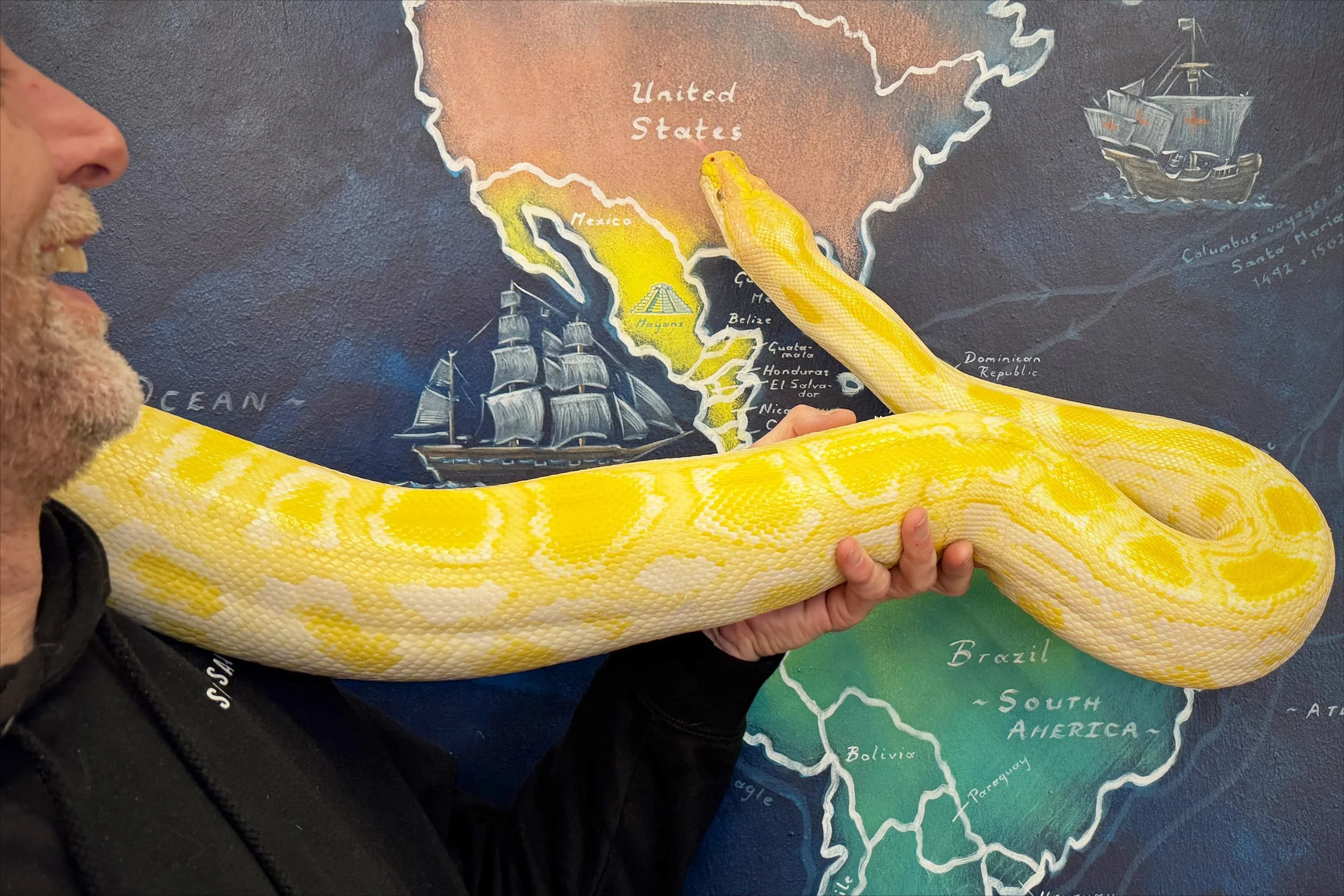
All of the animals in the Scaly Safari Crew are captive-bred rather than animals that have been removed from the wild. We are also very transparent about the fact that Scaly Safari is not a rescue. There is an important difference between rescue and rehoming, and we don't use those terms interchangeably.
Our Crew has been carefully built around individual animals whose history, temperament and behaviour make them suitable for the work we do. Many are first and foremost family pets that have grown up around people and are accustomed to human interaction.
We don't believe that belonging to a particular species automatically makes an animal suitable for public interaction, though. Two royal pythons can have completely different temperaments, just as two dogs can. We need to know the individual.
That means learning their preferences as well as their personalities. We know, for example, that Xander doesn't like his ears being touched, so anyone meeting him is told that before the interaction begins. Other animals have their own preferences, tolerances and behaviours that we've learned simply by spending a huge amount of time with them.
Suitability isn't permanent either. An animal being suitable for this work last year doesn't automatically mean they'll be suitable next year. We continually reassess.
Deciding who comes with us
We don't have a standard box of animals that gets loaded into the van every morning. The Crew for each event is selected individually, and quite a lot goes into that decision.
We consider:
how each animal is behaving that day;
their physical condition;
feeding schedules and recent meals;
shedding cycles;
how recently they've attended another event;
the length of the journey;
expected temperatures and environmental conditions;
the type and length of the event;
the age and needs of the people we're working with;
the venue itself; and
anything else that might affect that particular animal.
For longer journeys, we only take animals that we know travel well and whose environmental requirements we can safely maintain throughout the journey.
Having a larger Crew also means we can rotate animals rather than continually relying on the same individuals. We don't have just one large snake, for example, which means one animal doesn't have to attend every event simply because people enjoy meeting a big snake.
Some animals might attend an event and then have a substantial period of rest. Others may be taken out of rotation completely for a while. It depends on the individual.
This is also why we never guarantee that a particular animal will attend an event, even if someone has specifically asked to meet them. We understand that this can occasionally be disappointing, but the animal doesn't know that somebody requested them three weeks ago.
If they're not coming, they're not coming.
Interaction and handling
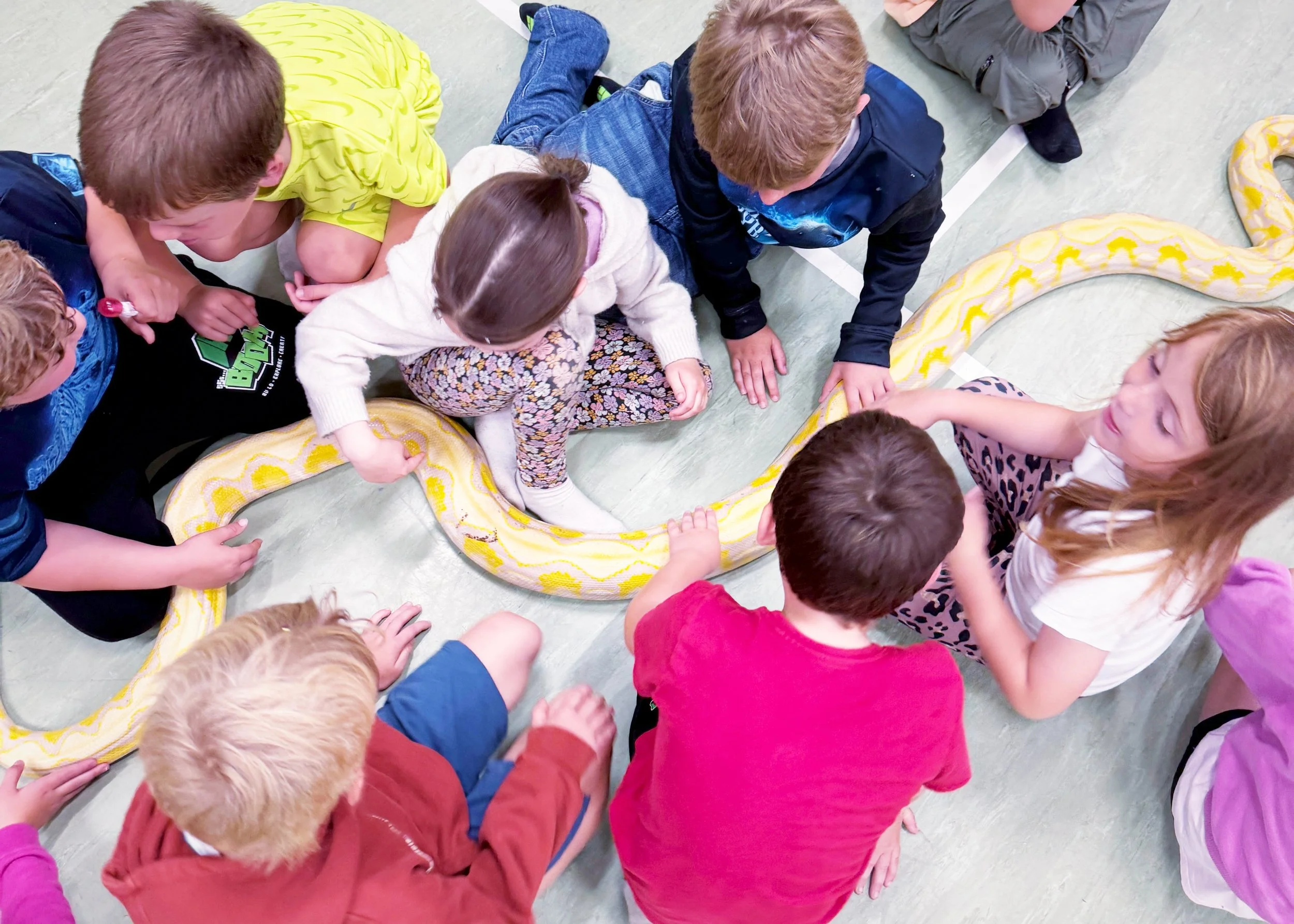
Interaction with our animals is an important part of what we do. In schools, for example, physically meeting an animal can transform an abstract lesson into something a child remembers for years. We also work with children with additional needs and elderly residents living with conditions such as dementia, where touch and sensory interaction can be particularly meaningful.
That doesn't mean we believe animals should be handled constantly. We try to achieve the purpose of the activity with as little disruption to the animal as reasonably possible.
All public handling is supervised. Before someone interacts with an animal, we explain how to do so appropriately. That might mean supporting the animal in a particular way, moving slowly, keeping hands away from sensitive areas or following a boundary specific to that individual animal.
And we're watching the animal as well as the participant. If we see something that concerns us, the interaction ends.
Our snake handling policy
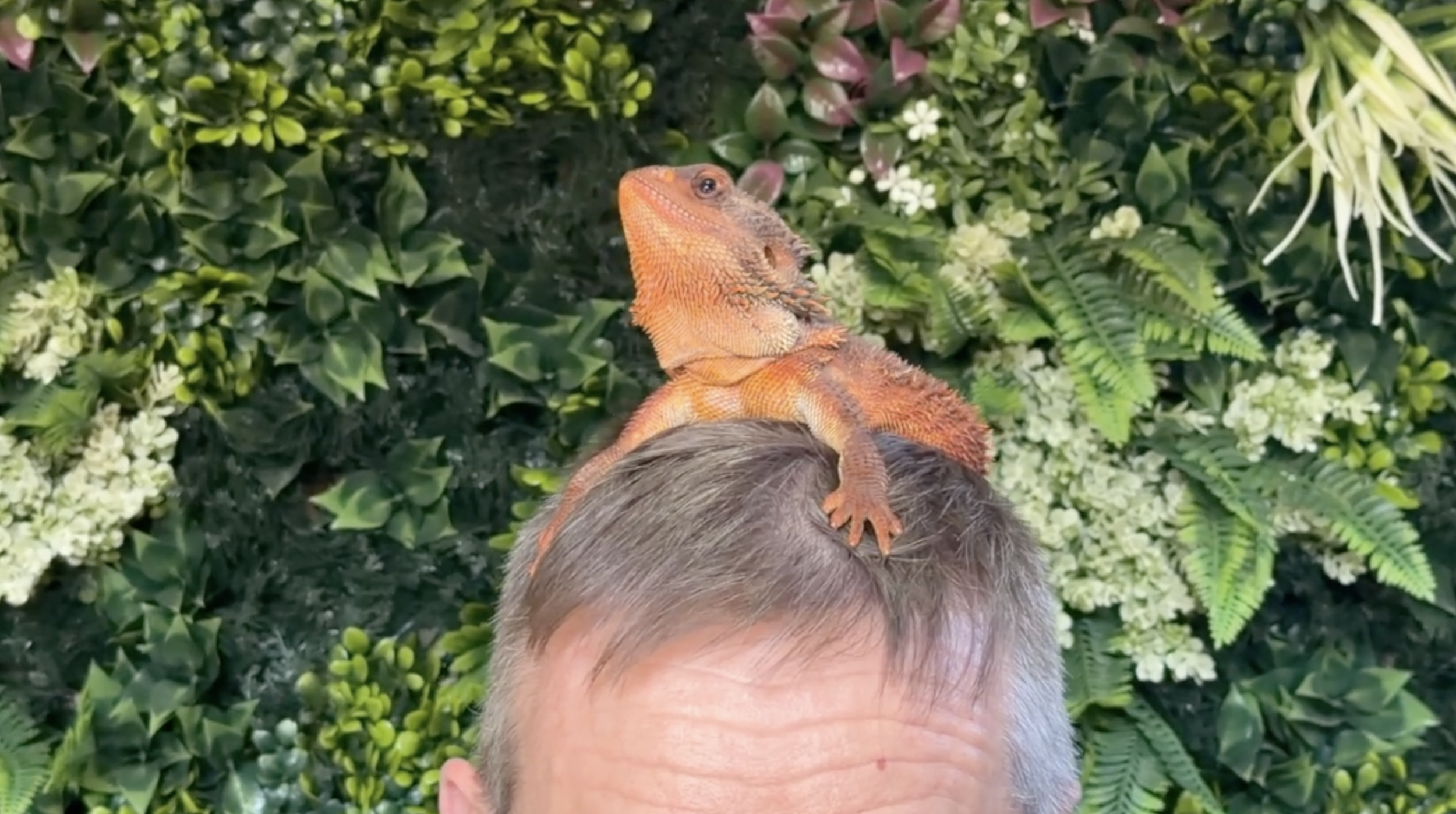
When someone handles one of our snakes, we want them to be actively involved in supporting the animal rather than simply having a snake placed on them for a photograph.
As a general rule, we don't put snakes around people's necks. This isn't because we believe that a snake touching someone's neck is inherently harmful to the snake; it's because we've found that people, particularly nervous children, tend to have a better experience when they feel in control of the interaction and can see and support the animal properly.
There may be circumstances where we use our discretion, but it isn't our default way of presenting snakes.
Our tarantula handling policy
Tarantula handling is an area where we deliberately don't have a simplistic yes-or-no philosophy.
As a general rule, we regard tarantulas as observational animals rather than animals that need to be handled, and we don't advocate routinely handling pet tarantulas simply for the sake of doing so.
However, our thinking on this has evolved.
We've seen the extraordinary effect that a carefully managed interaction can have on somebody who has spent their life frightened of spiders. Allowing a suitable tarantula to gently walk across someone's hand can turn fear into fascination in a matter of seconds. For a child, feeling how surprisingly delicate and soft a tarantula is can challenge everything they thought they knew about spiders.
We think that educational benefit matters, but it still has to be balanced against the individual animal.
Talulah, for example, isn't offered for public handling. Honey may sometimes be, depending on her behaviour and the circumstances on the day. Where we do facilitate tarantula handling, participants are seated, the interaction takes place over an appropriate surface to minimise fall risk, and we closely supervise the entire interaction.
So our policy really is sometimes yes, sometimes no. It depends on the individual spider, the environment, the participant and what we're trying to achieve through the interaction.
Our scorpion handling policy
This one is much simpler. Members of the public do not handle our scorpions.
They can still be fascinating animals to observe and learn about without needing to be held.
Travelling safely
Transport is an unavoidable part of mobile animal education, and we're very conscious that travelling means temporarily taking an animal away from its normal enclosure and environmental setup.
Scaly Safari holds the appropriate DEFRA animal transport authorisation for the journeys we undertake, but we don't regard having a licence as the end of our responsibility. Our job is to make each journey as safe and low-stress as we reasonably can.
Animals travel in secure, ventilated containers appropriate to the individual animal. Bigger isn't necessarily better when it comes to transport; for a snake, for example, an appropriately sized container can provide security and prevent the animal sliding around unnecessarily while the vehicle is moving. Containers themselves are securely restrained inside the vehicle.
Temperature is one of our biggest considerations. We use Bluetooth thermometers connected to our phones so we can continuously monitor temperatures during transport, with alerts if a monitored environment moves outside the parameters we've set. We also monitor the ambient temperature in the animal compartment.
Where additional heat is required, we have appropriate heating equipment and large portable battery units available to power it, alongside emergency backup provisions should a power source fail.
Animals are checked before travelling and again afterwards. For longer journeys, we are particularly selective about which species and individuals travel with us.
Most importantly, if we don't believe environmental conditions are appropriate for safe transport, we don't travel.
Life at home
The time somebody sees one of our animals at an event represents a very small proportion of that animal's life. Most of their time is spent doing the considerably less glamorous business of being a reptile, invertebrate or other exotic animal.
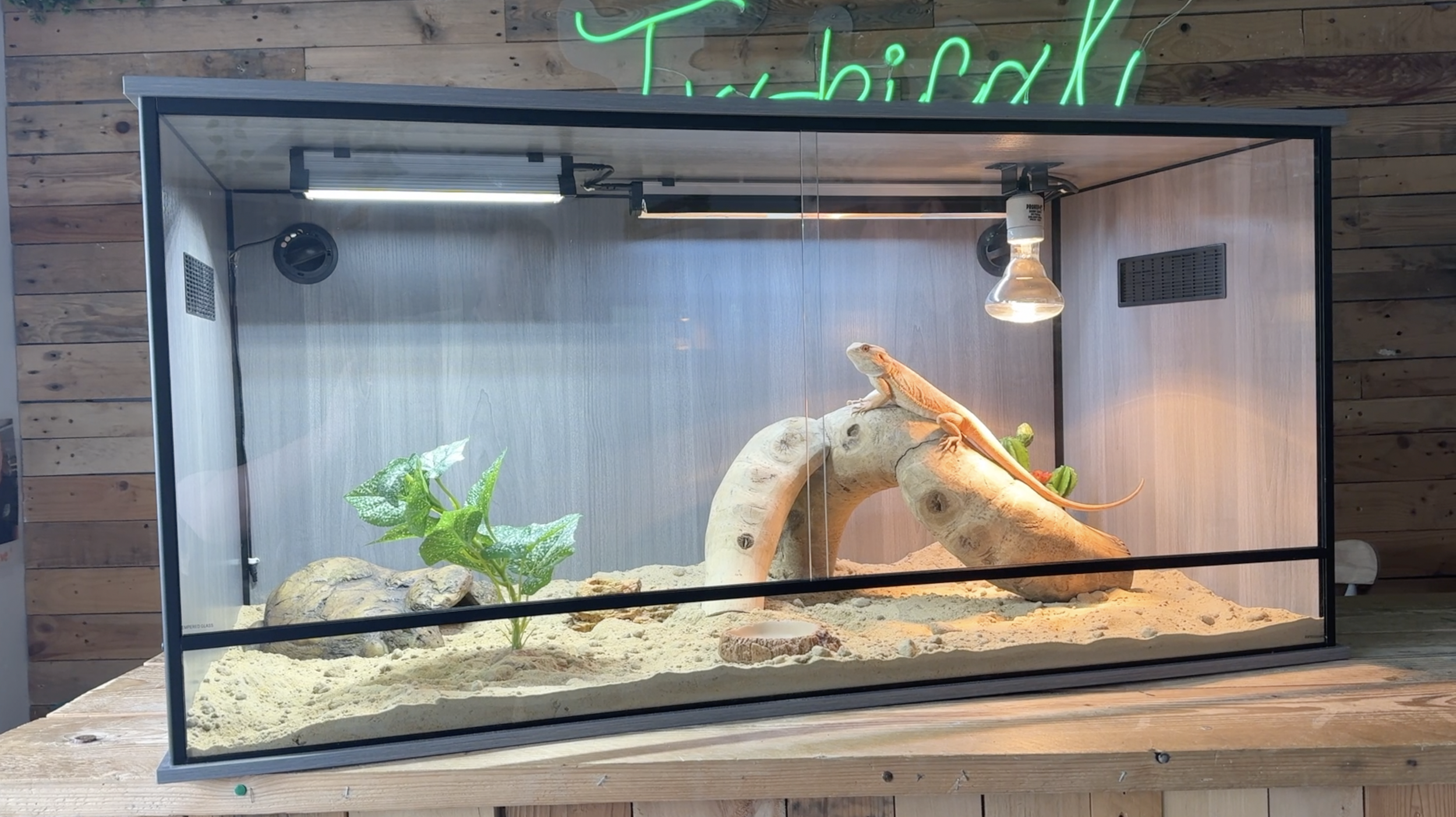
Our approach to housing is based around providing each species with an environment that allows appropriate natural behaviour and access to the environmental conditions it requires. Different species obviously need very different things, so there isn't a standard “Scaly Safari enclosure”.
Depending on the animal, that can include appropriate heating and thermostatic control, UV lighting, species-appropriate substrate, hides and shelter, branches and climbing opportunities, foliage, humidity control, suitable day/night cycles and other forms of environmental enrichment. Where appropriate, some of our enclosures are bioactive and contain their own clean-up crews.
Heating and lighting is automated, and individual equipment can be controlled remotely. We also use remote temperature and humidity monitoring, which means we can check environmental parameters even when we're away from the premises. Some enclosures also have cameras, allowing us to observe animals without disturbing them.
Enclosures are spot-cleaned routinely and receive deeper maintenance according to the needs of the particular species and setup.
Our guiding principle is that as far as reasonably possible, a captive environment should give an animal opportunities to behave in ways that are appropriate for its species and make choices about where it wants to be within that environment.
Food, husbandry and health monitoring
There isn't one Scaly Safari diet because there couldn't possibly be. A royal python, bearded dragon, tortoise, tenrec and tarantula all have completely different nutritional requirements.
Each animal receives food appropriate to its species and individual needs. We source frozen prey from specialist suppliers, gut-load live insects where appropriate, provide supplementation where required and offer dietary variety to species that benefit from it.
We also keep husbandry records, including important information about feeding, shedding and other observations. Every animal receives a visual health and welfare check at least daily, alongside the countless informal observations that happen while feeding, cleaning and caring for them. Animals attending events are checked before and after travelling.
What we're looking for isn't necessarily something dramatic. When you know an animal well, a subtle change can matter. A different posture, an unusual response, a change in appetite or something that simply isn't normal for that individual can all tell us that we need to look more closely.
If we're concerned about an animal, the event diary becomes irrelevant. The animal comes first.
Licensed, authorised and accountable
We don't expect people simply to take our word for it when we say that welfare matters to us.
Scaly Safari is registered with Denbighshire County Council for the exhibition/use of performing animals, and we hold the appropriate animal transport authorisation for our work. We also carry appropriate insurance and maintain the policies and procedures required for the activities we undertake.
That external accountability is important to us, but licences and paperwork aren't substitutes for good animal care. Meeting a legal minimum and providing excellent welfare aren't necessarily the same thing, and our ambition is not simply to tick the boxes required to operate legally.
We want our standards to keep improving.
What happens when welfare conflicts with a booking?
Our terms and conditions make it clear that booking Scaly Safari doesn't guarantee the attendance of a particular animal. We reserve the right to change the animals attending, withdraw an animal during an event, refuse a particular interaction or cancel an event altogether where welfare, weather or environmental conditions make that necessary.
That's not small print that we hope never to use. It's an important part of the way we operate.
If we've travelled for two hours and an animal tells us once we arrive that something isn't right, that animal doesn't participate. If someone booked because they desperately wanted to meet a particular member of the Crew and that animal is shedding, has recently eaten or simply isn't behaving normally that morning, they stay at home.
We would rather disappoint a customer than compromise an animal.
Yes, we're a business
We want to be transparent about this too: Scaly Safari is a business, not a charity, and we're not ashamed of that.
Providing excellent animal care costs money. There are enclosures, heating, lighting, food, substrate, enrichment, veterinary care, monitoring equipment, transport equipment, insurance and countless other costs involved in maintaining the standards we expect. The humans doing the work also need to make a living.
We don't think being a commercial business and genuinely adoring our animals are contradictory positions. In fact, financial sustainability allows us to invest in better equipment, improve environments, continue our education and make decisions based on welfare rather than simply on what is cheapest.
It also allows us to develop another part of Scaly Safari that is increasingly important to us: digital education.
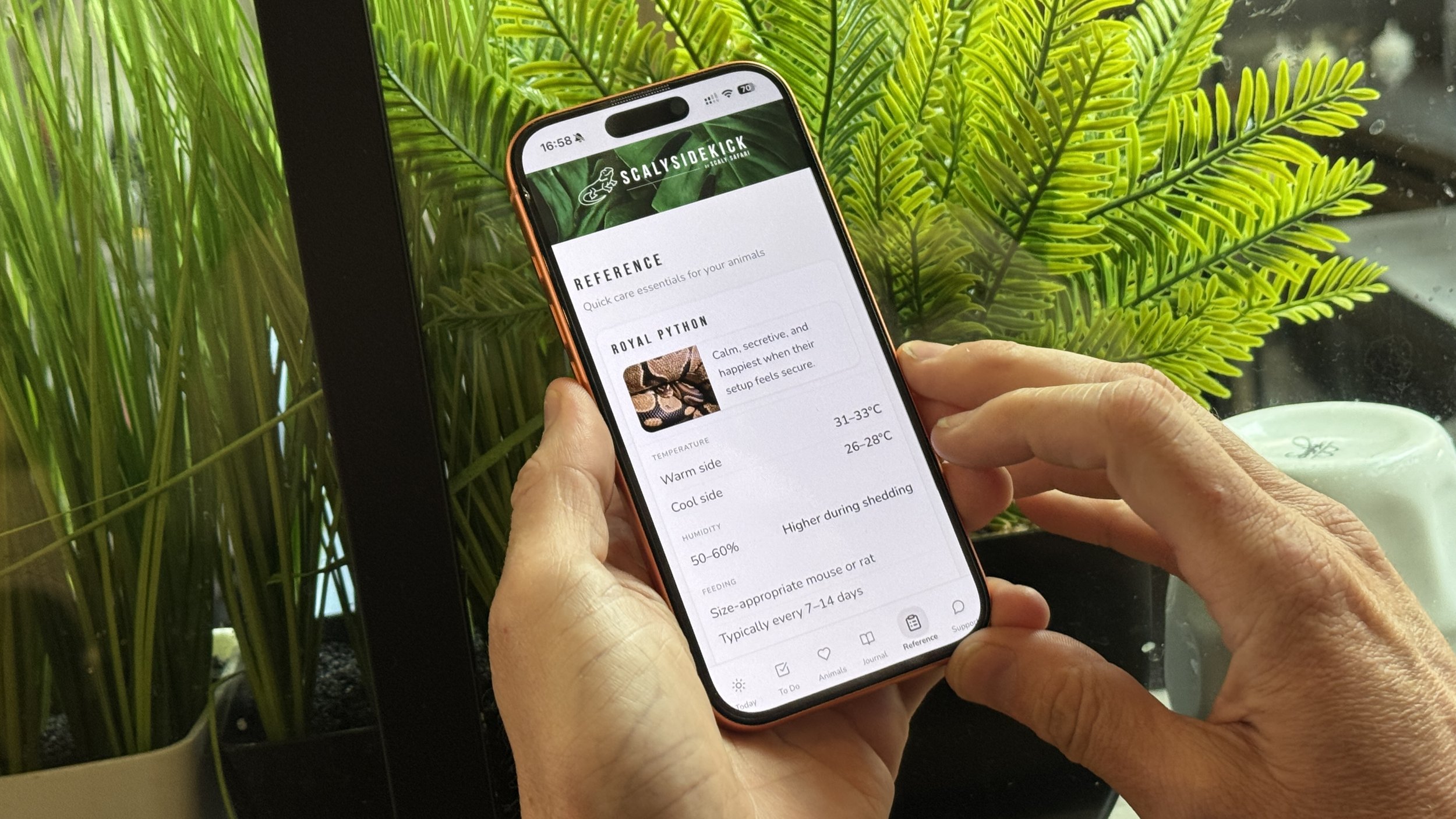
We're gradually building more ways to teach people about reptiles and responsible ownership without needing an animal physically present. We don't intend to stop our in-person work — we believe enormously in its value — but growing our educational reach shouldn't have to mean asking our animals to attend more and more events.
A sustainable business gives us the opportunity to grow without requiring a corresponding increase in the workload of the animals who helped us build it.
We don't always get it right
We think this is important enough to say publicly.
We don't know everything, and we don't always get everything right.
Reptile husbandry has changed enormously over the years and will continue to change. Research develops, technology improves and practices that were once widely accepted can be challenged by better evidence.
We don't want to become so attached to the way we've always done something that we stop listening when better information becomes available.
We're active within the reptile-keeping community and continue to learn from other experienced keepers, welfare organisations, professionals, emerging research and — importantly — the animals themselves. We welcome constructive, evidence-based conversations about what we do.
If somebody can show us a genuinely better way to care for one of our animals, we'd rather learn from it than defend our pride.
Our job isn't to prove that we're always right. It's to keep getting better.
The bottom line
Our animals make some extraordinary things possible.
We've watched people who were terrified of snakes become fascinated by them. We've seen children light up when something they've learned from a book suddenly exists in front of them. We've talked to families before they bought an animal and helped them understand the responsibility they were considering. We've seen older people connect with an animal through touch when conversation was difficult, and we've watched children leave an interaction wanting to know more about the natural world.
We believe those things matter.
But believing that our work has value doesn't give us permission to ignore its impact on the animals that make it possible. If anything, it gives us a greater responsibility to understand that impact, minimise it wherever we can and continually question whether the decisions we're making are the right ones.
Our animals aren't props or pieces of equipment. They're the Scaly Safari Crew, and without them none of this would be possible.
That's why their welfare will always come first.